
NYS cannabis packaging requirements changed enough in 2026 that brands should not treat old bag, box, jar, or tube artwork as automatically safe to reprint. The current rules affect the structure of the package, the front panel, required warnings, QR codes, universal symbol placement, plastic material documentation, and the way promotional claims connect to the package.
As of May 18, 2026, the key update is the amended Packaging, Labeling, Marketing, and Advertising framework. New York published the Notice of Adoption on December 3, 2025, and several packaging and labeling provisions have a six-month transition period. This means cannabis brands should be using this window to review artwork before the June 3, 2026 compliance date tied to the official publication date.
The practical issue is simple: a design can look clean and still fail if the required label information is too small, hidden, placed on the wrong panel, or built around artwork that appears too youth-oriented.
This guide breaks down the NYS cannabis packaging requirements that matter most before a brand prints new packaging. It focuses on design decisions, not legal theory.
What changed in the NYS cannabis packaging requirements for 2026
The biggest change is not one single label line. Instead, New York tightened and clarified the whole packaging and advertising system.
First, OCM clarified child-resistant and tamper-evident expectations. The package has to stay child-resistant for the useful life of the product, and the tamper-evident feature cannot block required information after the package opens.
Next, OCM updated labeling requirements around warnings, terpene profile disclosure when terpenes are marketed, processor information, and the way required details appear on the outermost package. Also, the rules now make the sustainability side harder to ignore because plastic packaging generally needs at least 25% post-consumer recycled content unless a specific exception applies.
Finally, the advertising side changed too. Discounts, coupons, loyalty programs, points-based rewards, and bundled discounts are now addressed more clearly, but those offers cannot be attached directly to a cannabis product package or label. That matters because packaging teams should not design printed bags that say things like “Buy One, Get One,” “Free Gift,” or “Loyalty Deal” on the package itself.
NYS cannabis packaging requirements that matter before artwork starts
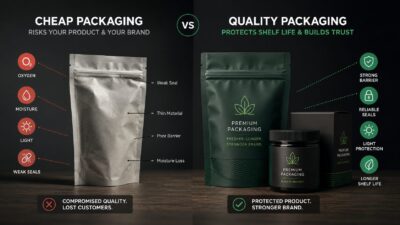
Before the designer touches the front panel, the package format needs to work. New York requires retail cannabis packaging to be child-resistant, tamper-evident, resealable if it contains more than one serving, fully enclosing, protective against oxygen exposure and contamination, and made from materials that do not add toxic or harmful substances to the product.
This affects format selection. For example, a multi-serving edible pouch needs a resealable child-resistant closure. A pre-roll tube needs a compliant child-resistant mechanism. A jar inside a box still needs the actual retail package to meet the rules, so the outer artwork cannot cover for a weak primary package.
Also, brands should keep child-resistant documentation on file. The OCM guidance points to federal special packaging standards and says the Office can request this documentation. That means compliance is not only a visual issue. It is also a paperwork issue.
Plastic packaging and PCR documentation
Plastic packaging is now a bigger design and sourcing decision. In general, cannabis product packaging cannot be made of plastic unless it contains at least 25% post-consumer recycled content.
However, there are exceptions for plastic components needed for child resistance and for items where no PCR option is available. If a brand relies on an exception, the licensee needs due-diligence documentation showing that it reviewed alternatives and found no available compliant option.
This is where the design file and the production file need to match. If the artwork calls for a clear plastic jar, plastic tube, plastic insert, or plastic child-resistant component, the compliance review should happen before the quote is approved.
Cannabis package design cannot appeal to people under 21
The most important creative rule is still the hardest one to apply: packaging cannot be attractive to people under 21.
New York lists several clear danger zones. Designs should avoid cartoons, mascots, imitations of candy, soda, cookies, cereal, toys, games, youth-oriented characters, and images of people who could reasonably appear under 21 unless that person is at least 25.
Also, OCM specifically warns that removing older examples such as bright colors or bubble-style fonts should not be read as permission to use them freely. In practical terms, a bright color palette is not automatically banned. But if the full design feels like candy, cereal, a kids’ snack, or a toy brand, it can still create a compliance problem.
Cultivar names create another design trap. New York generally allows strain names, even when the name includes words that could otherwise be youth-oriented. However, OCM encourages brands to minimize how those names appear when the cultivar name could appeal to people under 21. A safer layout is to keep the brand name and product category dominant, then place the cultivar name in a smaller, lighter, less prominent area.
Label design rules for the front panel
The Principal Packaging Display Panel, or PPDP, is the panel expected to face the customer at retail. It cannot be treated like a random back panel or bottom flap. It needs to be the visible panel that carries the brand name and required front-facing product details.
For non-inhalable cannabis products, the PPDP generally needs total THC and total CBD per serving and per package, other marketed phytocannabinoids per serving, number of servings, recommended serving size, net quantity, and brand name. For inhalable products, the PPDP generally needs total THC, total CBD, and other marketed phytocannabinoids as a percentage of weight or volume, plus net quantity and brand name.
This is where a lot of artwork gets messy. A designer may build a strong front label, then try to squeeze potency, servings, net quantity, symbol placement, and brand hierarchy into the last 10% of the layout. Instead, the compliance content should be placed first. Then the brand artwork should be built around it.
Required warnings, symbols, QR codes, and product details
The outermost packaging layer has to carry the required warnings, ingredient list, expiration date, lot number or barcode, storage conditions, processor details, usage instructions for edibles or topicals, applicable solvent disclosure, and a scannable barcode or QR code that links to the Certificate of Analysis.
However, the QR code does not replace printed label information. OCM states that required information must appear on the retail package or marketing layer in at least 6-point font. For small products, layered labels can help, but the QR code cannot become the shortcut for content that should be printed.
The universal symbol also needs to be treated as a fixed compliance element, not a logo that can be redesigned. New York allows square, vertical, or horizontal versions, sets minimum sizes, and says the symbol must stay visible, contrasting, and unaltered. It also cannot be used as a tamper-evident seal or placed where it will be removed by the consumer.
Small-format packaging needs a real label plan
Small packaging is where the NYS cannabis packaging requirements become most restrictive. Concentrate jars, pre-roll tubes, vape boxes, and tiny edible packs often do not have enough clean surface area for every required line.
That does not mean the brand should shrink everything until it barely fits. New York allows certain required information to appear on accordion, booklet, dry release, expandable, extendable, peel-and-reseal, or similar labels. But the PPDP requirements, universal symbol, and two core warnings cannot be hidden inside those layered formats.
Because of that, small-format packaging should be planned as a system. The front panel carries the highest-priority retail information. The back or side panel carries required supporting details. Then a booklet or peel-and-reseal label can hold longer ingredient, warning, and batch information where allowed.
Advertising design changes that affect packaging campaigns
The 2026 changes also matter for launch graphics, social ads, retail signage, and promotional assets. Advertising generally needs required warning language, rotating health warnings, HOPEline information unless exempted, license details in many formats, and audience controls showing that the audience is expected to meet the 21-plus requirement.
Also, outdoor sign rules are stricter than normal brand signage. Billboards are prohibited. Outdoor signs can only include limited business information, such as name, address, directions, contact information, website, and licensed activity.
For cannabis brands, the key point is that campaign design and packaging design need to match the same compliance logic. A compliant bag can still be paired with a non-compliant ad. A clean social graphic can still fail if it makes a medical claim, depicts consumption, promotes overconsumption, or uses youth-oriented creative.
How Beast Coast helps brands design around NYS cannabis packaging requirements
Beast Coast Packaging works with cannabis brands that need packaging to look retail-ready while leaving room for required compliance content. That includes custom bags, boxes, jars, pre-roll tubes, and labels for flower, pre-rolls, edibles, concentrates, vapes, topicals, tinctures, and CBD or hemp products.
The best process is simple. First, choose the right compliant format. Next, map the required label information before the artwork is finalized. Then build the brand design around the compliance layout instead of forcing compliance into empty space after the design is done.
Beast Coast offers custom packaging with a 500-piece MOQ, free digital proof before printing, and an estimated three-week turnaround from proof approval. Also, brands that need design help can use Beast Coast’s $250 design service with 3 revisions.
Get a custom cannabis packaging quote
If you are printing new packaging for the New York market, do not treat old artwork as ready for another production run. The NYS cannabis packaging requirements have enough detail that every panel, warning, claim, symbol, QR code, and material choice should be checked before printing.
Submit your product details, package type, size, quantity, and artwork files. Beast Coast can help recommend the right bag, box, jar, tube, or label setup before your next production run.