
Introducing Stacked UV Printing
We’ve added a new printer to our production line that unlocks stacked UV printing, a finish that goes beyond traditional spot gloss by physically building height into the label. Instead of applying a single flat layer of UV, stacked UV allows multiple passes to be layered on top of one another, creating real dimensionality you can see and feel. This is not a cosmetic effect. It changes how a label reads in the hand and how the eye moves across the design.
What Stacked UV Changes
Standard spot UV applies one level of gloss to selected areas of a label. Everything lives on the same plane, meaning contrast is limited to shine versus matte. With stacked UV, we can control elevation across the design. Certain elements can be built higher while others remain subtle or flat, allowing the artwork to exist in layers rather than as a single surface.
This gives designers control over hierarchy in a way ink alone cannot. Logos, illustrations, or key typography can be pushed forward physically, while textures, patterns, and secondary elements sit back. The label gains structure instead of relying on visual tricks to guide attention.
Why This Matters in Packaging
Depth is processed faster than detail. When a consumer picks up a jar or sees it on a shelf, their eye immediately reads what sits highest and what recedes. Stacked UV creates instant prioritization without cluttering the design or adding unnecessary color. It allows the most important elements to command attention while keeping the overall composition clean.
This is especially effective for minimal, monochrome, or high-contrast designs where restraint matters. Instead of adding more graphics, stacked UV adds dimension. The packaging feels deliberate, engineered, and premium rather than decorative.
Example: Clazzicz 50ml Miron Jar Setup
The Clazzicz 50ml Miron jar is a strong example of how stacked UV should be used. The brand name and main illustration are built up to the highest level, placing them firmly in the foreground. Background textures and supporting elements are layered lower, adding grit and character without competing for attention. Even in a black and white colorway, the label separates clearly because elevation replaces color as the primary differentiator.
The result is a label that reads instantly, feels substantial in hand, and reinforces quality through execution rather than excess.
Available Across All Label Applications
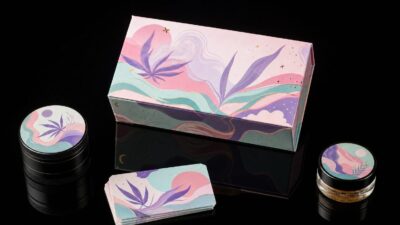
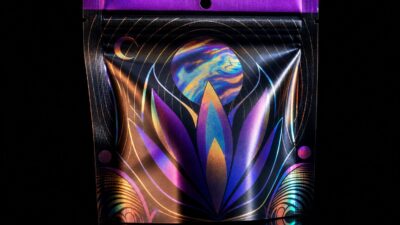
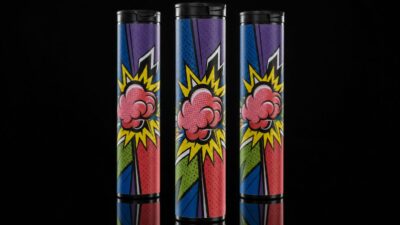
This finish is not limited to one format. Stacked UV is now available across all of our label jobs, including glass and plastic jars, sticker bags and pouches, tubes, lighters, and slap stickers. Cap labels, side labels, wrap labels, and multi-label systems can all be produced using this process.
Wherever a label exists, stacked UV can be applied strategically to enhance depth and clarity.
When Stacked UV Makes Sense
Stacked UV is most effective when used with intention. It works best when a design needs hierarchy without additional color, when a logo or character should anchor the packaging, or when a brand wants a tactile, premium feel that customers notice immediately upon handling the product. Overuse flattens the effect. Selective application is what gives stacked UV its strength.
This is a finish for brands that care about how packaging is read, not just how it looks.
Next Steps
If you already have artwork, we can review it and recommend where stacked UV will add the most value. If you are designing from the ground up, this finish can be planned into the layout from the start so depth is intentional, not forced.
Stacked UV printing is now live at Beast Coast and available for all qualifying label projects. If you want packaging that communicates quality through structure and execution, this is the finish to build with.